
Quick answer: There is no real contest — “safety toe” is the category, and “steel toe” is one member of it. Any cap that protects the toes (steel, composite, or alloy) is a safety toe. So when a product says “safety toe,” ask which material and which certification rating — that is what actually determines protection, weight, and price.
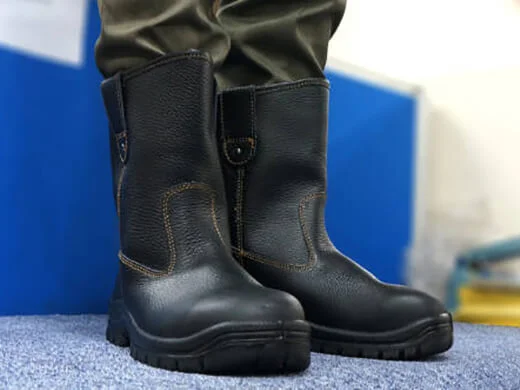
“Safety Toe” Is a Category, Not a Material
The phrase safety toe (also written safety toe cap) describes the reinforced area built into the front of a safety shoe to protect against falling objects, crush injuries, and compression. It says nothing about what the cap is made from.
Three materials dominate the market:
- Steel toe — tempered steel; the original and most common safety toe.
- Composite toe — non-metallic materials such as fiberglass, Kevlar, and carbon fiber.
- Alloy / aluminum toe — lightweight metal alloys, lighter than steel but still metal.
All three qualify as safety toes, and all three can be certified to the same EN ISO 20345 impact rating of 200 joules. The material changes the trade-offs, not the basic protection level.
Steel Toe vs the Other Safety Toe Types
| Toe type | Material | Metal detector | Weight | Typical cost |
|---|---|---|---|---|
| Steel toe | Tempered steel | Triggers alarm | Heaviest | Lowest |
| Composite toe | Fiberglass / Kevlar / carbon fiber | Passes through | Light | Highest |
| Alloy / aluminum toe | Aluminum or light metal blend | Triggers alarm | Lightest metal | Mid |
If you want the full breakdown, see our Steel Toe vs Composite Toe guide and Alloy Toe vs Steel Toe guide.
Why the Confusion Exists
Retailers and marketplaces often use “safety toe” and “steel toe” as if they were interchangeable. This happens for three reasons:
- Default assumption: Steel was the first widely used cap, so “safety toe” became shorthand for it.
- Simplified listings: A single product field labelled “toe type: safety” hides the actual material.
- Regional wording: Some markets say “safety toe,” others say “steel toe,” for the same budget boot.
The practical fix: ignore the marketing label. Look at the material description and the standard code instead.
How to Read the Label
A certified safety shoe carries an EN ISO 20345 code. The prefix tells you the base protection level:
- SB — basic toe protection (200 J impact).
- S1 — SB plus antistatic, energy absorption, and slip resistance.
- S1P / S3 — adds puncture resistance; S3 adds water resistance and a cleated outsole.
Any of these codes confirms the boot has been tested. The code does not reveal the toe material — that is listed separately as steel, composite, or alloy. For the full grading system, read our Footwear Category Classification guide.
Which Should You Specify?
- Heavy industry, smelting, mining, tight budgets → steel toe.
- Airports, secure facilities, electrical work, cold storage → composite toe.
- Long shifts, light industrial, fatigue-sensitive teams → alloy toe.
At VITOPPE (Qingdao Vitosafe), we supply all three toe types as factory-direct, OEM/ODM lines. Every model is SGS/CTC tested, EN ISO 20345 certified, and backed by 740+ client partnerships across 12+ countries — so you can specify by hazard, not by label confusion.
Frequently Asked Questions
Is a safety toe the same as a steel toe?
No. “Safety toe” is the umbrella term for any protective toe cap, while “steel toe” is one specific type made of steel. Composite and alloy toe caps are also safety toes.
What are the three main types of safety toe?
Steel, composite (non-metallic), and alloy/aluminum. All three can meet the same EN ISO 20345 impact rating of 200 joules, but they differ in weight, metal-detector behavior, and cost.
Does “safety toe” mean the boot is certified?
Not by itself. The word describes the protective cap, not the certification. Check for an EN ISO 20345 rating code such as SB, S1, or S3 on the label to confirm the boot meets a tested standard.
Which safety toe should I specify for my team?
Choose steel for heavy industry and bulk value, composite for metal-detector or electrical environments, and alloy for lighter all-day comfort. Match the cap to the hazard, not the label wording.
Conclusion
“Safety toe vs steel toe” is a category-vs-product comparison, not a competition. Once you know the material and the certification code behind the phrase, the right choice becomes straightforward — and your team gets certified protection matched to the real hazard.