
Slips and falls are the number one cause of workplace injuries worldwide.
They happen on wet floors. On oily surfaces. On metal grating. Even on surfaces that look perfectly dry.
The right pair of best safety shoes with proper slip resistance is your first line of defense. Whether you’re looking at a safety toe work shoe for a factory floor or a lightweight option for a kitchen environment — understanding how slip resistance actually works helps you make the right choice.
This guide breaks it all down.
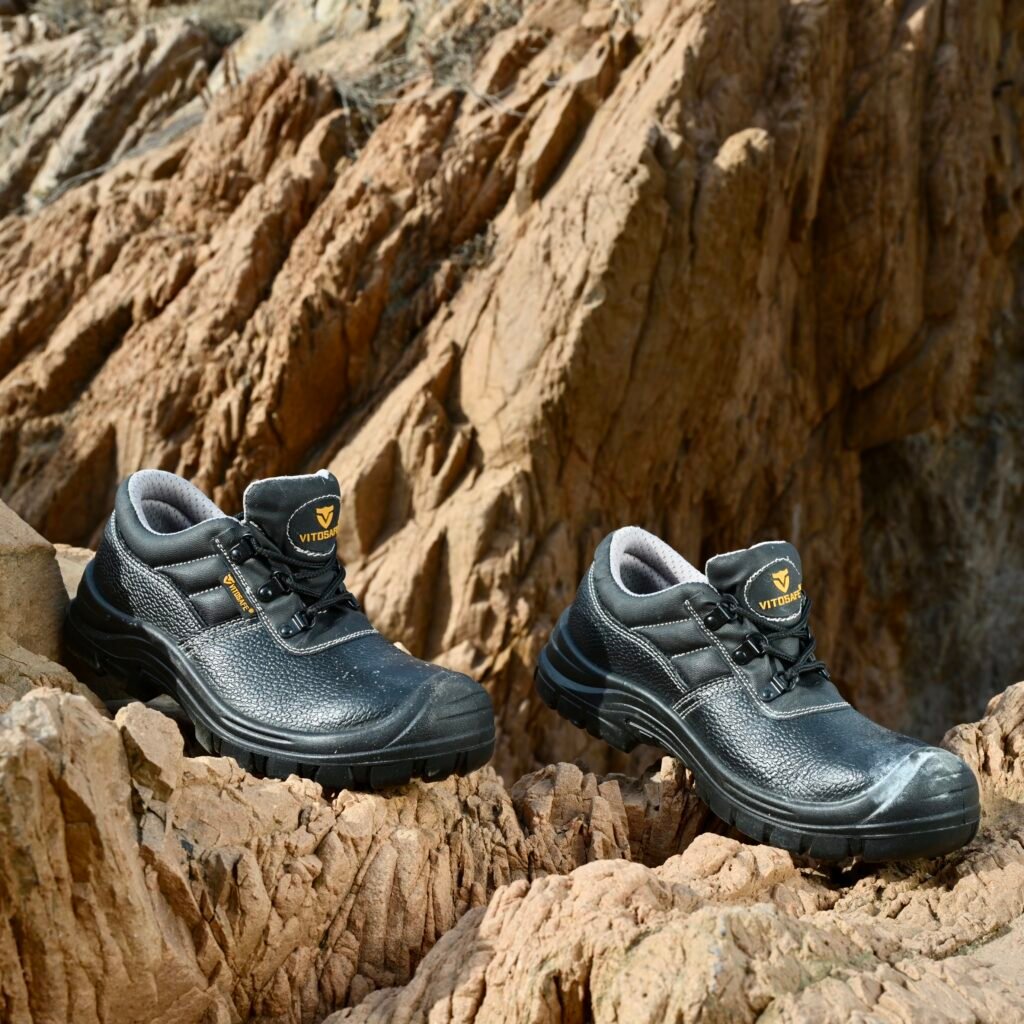
What Is Coefficient of Friction (COF)? How Is Slip Resistance Measured?
Slip resistance is not a vague marketing claim. It is a measurable property.
The measurement is called the Coefficient of Friction (COF).
COF measures the friction between a shoe sole and a surface. The higher the COF, the better the grip.
Here’s a simple scale:
- COF below 0.2 — Dangerously slippery. High risk of falls.
- COF 0.2 – 0.4 — Marginal grip. Risky on wet or oily surfaces.
- COF 0.4 – 0.6 — Acceptable for most dry surfaces.
- COF above 0.6 — Good slip resistance. Suitable for wet and oily environments.
Safety shoe manufacturers test COF on multiple surface types — dry, wet, and oil-contaminated.
When shopping for non-slip safety shoes, always look for products with documented COF test results. A shoe labeled “slip resistant” without any test data is not a guarantee of safety.
The 3 Core Design Elements of a Non-Slip Outsole
Not all rubber soles are equal. Three factors determine how well a sole grips the ground.
1. Rubber Compound Hardness
Softer rubber conforms to surface irregularities. It creates more contact area between the shoe and the floor. More contact means more friction — and better grip.
Hard rubber lasts longer. But it grips less effectively on wet or oily surfaces.
The best non-slip safety shoes use a carefully balanced rubber compound — soft enough to grip, durable enough to last.
2. Tread Pattern Depth
Deep tread channels cut through surface liquids. They allow water and oil to escape from under the sole as you step.
Shallow tread patterns fill up with liquid quickly. Once filled, the tread can no longer grip — and the shoe becomes dangerously slippery.
Look for safety shoes with tread depth of at least 3–4mm for wet environment use.
3. Drainage Channel Design
The pattern of channels between tread blocks matters as much as depth.
Effective drainage channels run in multiple directions. This ensures liquid escapes regardless of the angle or direction of your step.
Narrow, poorly designed channels clog easily with grease or food particles. Wide, multi-directional channels stay clear and functional longer.
Matching Slip Resistance to Your Floor Type
Different floor surfaces require different non-slip solutions.
| Floor Type | Main Hazard | What to Look For |
|---|---|---|
| Oily / Greasy Floors | Oil film creates near-zero friction | High COF outsole with wide drainage channels. Essential for safety toe shoes for men in manufacturing or kitchen roles |
| Wet / Water-Covered Floors | Water reduces surface contact | Deep tread pattern + soft rubber compound |
| Smooth Tile or Concrete | Minimal surface texture | Micro-textured outsole for maximum contact area |
| Metal Grating | Narrow contact points + wet conditions | Specialized outsole with small, firm tread blocks |
| Outdoor / Uneven Terrain | Variable surfaces + mud | Aggressive deep-lug tread pattern |
Choosing slip resistance based on your actual floor type is critical.
A shoe that performs perfectly on wet tile may fail completely on an oil-coated factory floor.
Why Slip Resistance Decreases Over Time
A brand-new pair of non-slip safety shoes performs at its best.
But slip resistance degrades with use. Here’s why:
Tread wear: Every step grinds down the tread pattern. As tread depth decreases, drainage capacity drops. Less drainage means less grip on wet surfaces.
Rubber hardening: Rubber compounds harden over time — especially with heat exposure. Harder rubber grips less effectively. UV exposure, chemical contact, and age all accelerate this process.
Clogged tread channels: In food processing, kitchen, and industrial environments, grease and particles accumulate in tread channels. Clogged channels cannot drain liquid. A clogged sole performs almost as poorly as a flat sole.
The result: A safety shoe that provided excellent grip when new may provide dangerously poor grip after 6–12 months of heavy use.
This is why regular inspection and timely replacement of safety footwear matters.
How to Extend the Life of Your Non-Slip Outsole
You can slow the degradation of slip resistance with proper care.
Clean your soles regularly. After each shift, remove grease, food particles, and debris from tread channels. Use a stiff brush and mild detergent. Pay attention to the tread grooves — not just the flat surface.
Inspect tread depth monthly. Use a tread depth gauge or a simple coin test. If tread depth has worn below 2mm, grip performance is significantly reduced.
Avoid extreme heat. Do not dry safety shoes near open flames, radiators, or in direct sunlight. Heat hardens rubber compounds and accelerates sole degradation.
Rotate between two pairs. Alternating between two pairs of shoes extends the life of both. It also allows each pair to fully dry between shifts — reducing rubber breakdown from moisture exposure.
Know when to replace. No amount of cleaning restores worn tread. When tread is visibly worn flat, replace the shoes immediately. The cost of a new pair is always less than the cost of a slip-and-fall injury.
Choosing the Right Non-Slip Safety Shoe for Your Role
Slip resistance is just one part of the equation.
Your safety shoe also needs to match the other hazards in your environment.
For men in manufacturing, logistics, or construction: Safety toe shoes for men with steel or composite toe protection combine impact resistance with high-COF outsoles. Safety toe shoes men styles are available in both heavy-duty boot and lightweight athletic formats.
For women in food processing, healthcare, or retail: Women’s safety toe work shoes with non-slip outsoles are designed on female-specific lasts for a secure, comfortable fit. Lightweight construction reduces fatigue across long shifts without sacrificing grip.
For workers who need mobility and speed: Safety toe athletic shoes combine sports shoe comfort with certified slip resistance and toe protection. These are ideal for warehouse pickers, logistics staff, and anyone who needs to move quickly across mixed surfaces.
For workers in electrical or light industrial environments: Safety composite toe shoes offer non-conductive toe protection alongside high-performance slip-resistant outsoles — without the weight of steel.
Vitoppe Non-Slip Safety Shoe Collection
Vitoppe designs slip-resistant safety footwear for real work environments.
Every pair in our collection features:
- Tested slip-resistant outsoles with documented COF performance
- Deep multi-directional tread channels for effective liquid drainage
- Rubber compounds balanced for durability and grip
- Available in steel toe and composite toe configurations
Our non-slip range includes:
- Safety toe shoes for men in heavy-duty and athletic styles
- Women’s safety toe work shoes built on female-specific lasts
- Safety toe athletic shoes for high-mobility work environments
- Safety composite toe shoes for electrical and light industrial roles
All Vitoppe safety shoes are CTC and SGS certified. Every pair is tested before it leaves our facility.
👉 [Shop Non-Slip Safety Shoes for Men →]
👉 [Shop Women’s Non-Slip Safety Toe Work Shoes →]
👉 [View Full Non-Slip Collection →]
Conclusion
Slip resistance is not a feature you can see clearly from a product photo.
It is an engineering outcome — built into the rubber compound, the tread design, and the drainage channel pattern of every sole.
Here’s what to remember:
- Check COF test data — not just marketing claims
- Match your outsole to your specific floor type
- Inspect tread depth monthly and clean soles after every shift
- Replace shoes when tread is worn — before an accident happens
- Choose the right toe protection alongside your slip-resistant sole
The best safety shoes are not just the ones with the highest protection rating. They are the ones that match your environment, your foot, and your daily workload.
Need Help Choosing the Right Non-Slip Safety Shoe?
Tell us where you work and what surfaces you walk on. Our team will recommend the right non-slip safety shoe for your role — steel toe, composite toe, athletic, or heavy-duty.